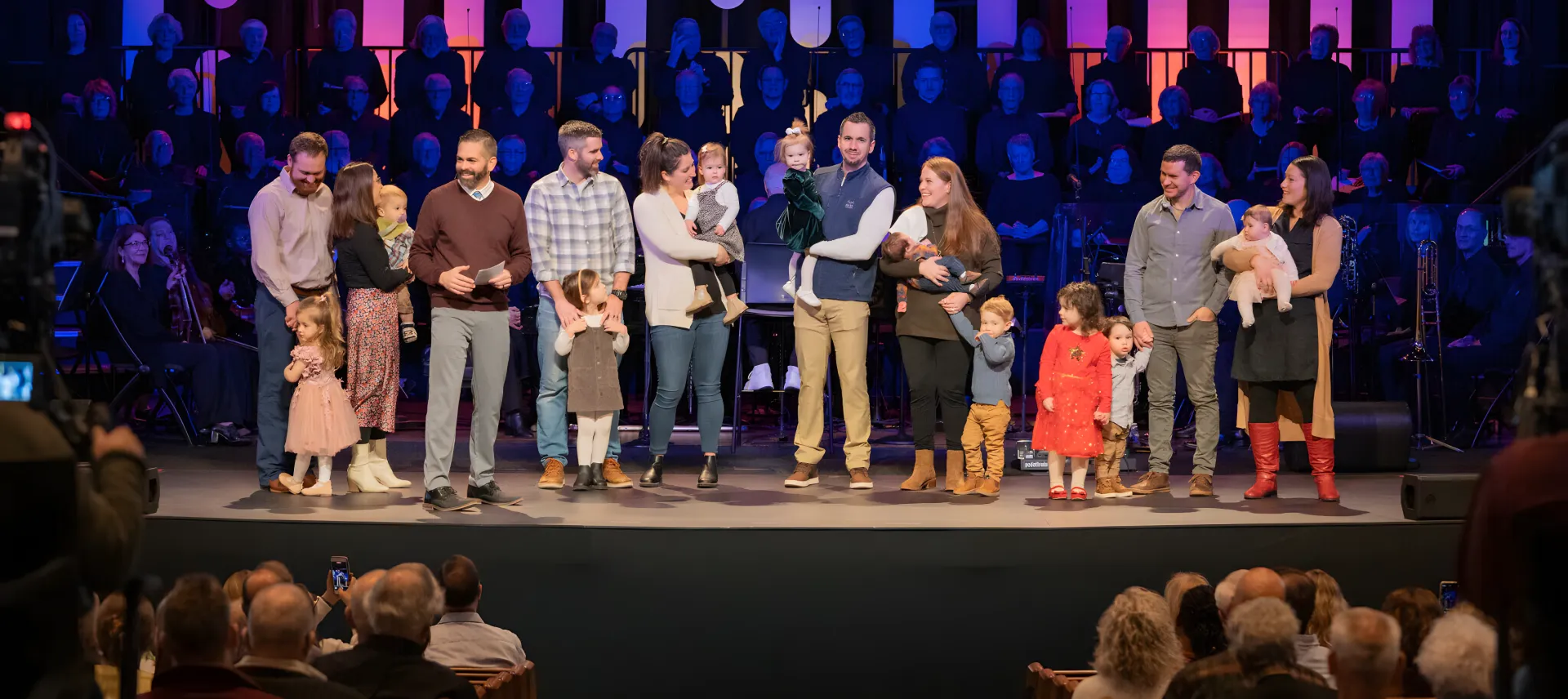
Families with young children on stage during a child dedication service at a partner church

Your church already cares
about foster children.
We help you do something about it.

Across Georgia, churches partner with us to recruit foster families from their congregations, support them after placement, and surround every family with the local community they need — the people, prayer, and practical care that carry a family through until reunification.

You don’t need to start a program from scratch. You need a partner who already runs one.

§ 01 · The partnership

What partnership actually looks like.

Not a fundraising relationship. Not a sermon series. One Christian organization coming alongside a Christian congregation — to do work that's already on your heart.

When your church partners with us, three things happen in your community.

01

Foster families get recruited from your congregation.

We come alongside you with information sessions, training resources, and the language pastors need to invite people in without pressuring them. Our foster families are Christians active in a local church — exactly the families your congregation already knows.


02

Those families get supported by people who know them.

A foster family with a church family stays fostering. The number that proves it: 9 in 10 of our foster families are still fostering after their first year.

03

Children land in a community that already cares.

When your congregation partners with us, the foster families we license alongside you are surrounded by people who know them — church members, neighbors, and a regional team down the road. That local network is what carries families through the hard middle and gives children the steady community they need.

You don’t need clergy training in social work. You need a congregation that’s willing — and a partner that handles the rest.

§ 02 · The ask

What we ask of partner churches.

We try to be specific so you can decide quickly.

01
STEP

One internal champion.

Usually a pastor, ministry director, or lay leader who carries the relationship inside the church. Not a committee.

02
STEP

Two info sessions a year.

We bring the materials, the speakers, and the format. Your church provides space and an invite to the congregation.

03
STEP

Visibility from the pulpit when it fits.

A bulletin insert, a brief mention during ministry highlights, a once-a-year sermon if it lands naturally — not a year-round messaging campaign.

04
STEP

Practical care for placed families.

Meal trains, respite weekends, school supply drives, prayer support. Things your church already knows how to do for new parents — applied to foster families.

That’s it. We don’t ask churches to run training, manage cases, or take on legal responsibility. That’s our job.

§ 03 · What we bring

What partner churches get from us.

The operational scaffolding so your church can do what it does best — show up for families.

01
A dedicated regional staff contact
For your church, and for every foster family you recruit.
02
NTDC pre-service training
Taught by us. Required for every F4F foster parent.
03
The full home-study and licensing process
For any family your church recruits — start to finish.
04
Ongoing case management and 24/7 support
After placement, when the hard middle starts.
05
Materials, talking points, presentation support
For your info sessions, bulletin inserts, and pulpit mentions.
06
Connection to other partner churches
In your region. You're not the only one doing this.
§ 04 · The why

Why churches do this with us.

The case for foster care ministry is centuries old. The case for doing it with F4F is operational.

The case for foster care ministry is the same one churches have been making for centuries — care for the orphan and the vulnerable, mend what’s broken in families, be present in your community. The case for doing it with F4F is operational:

01 · Shared foundation

A Christian foster care agency, not a secular vendor.

F4F follows the National Association of Evangelicals' Statement of Faith. Our families share that foundation. Partnership with us isn't asking your congregation to align with a secular vendor — it's working alongside an organization grounded in the same convictions.

02 · Local support

Every family has real support close at hand.

Nine regional offices, partner churches in every part of the state, and other foster families within reach — that's the network F4F builds around every household we license. For most children in foster care, the goal is going back to their birth families. Families backed by a real local community are the ones who sustain through that hard middle. Your church becomes a load-bearing part of that support system.

03 · Track record

We've done this with churches across Georgia.

Nine regional offices. Partner churches in every part of the state. We've handled the slow, complicated, regulated parts of foster care for years. Your church gets to do what it does best — show up for families.

04 · Measurement

We measure what matters.

9 in 10 retention. Nine offices across Georgia. Largest nonprofit child-placing agency in the state. We’re forward about the numbers because the numbers are what tell us the model is working.

§ 05 · Where to start

Most partnerships start with a single conversation.

Most churches that end up partnering with us start with a conversation — usually 30 minutes, usually with the pastor or ministry leader and one or two members of our regional team.

We come to you. We answer your questions. There’s no commitment from that conversation, and most churches take a few weeks afterward to discuss internally before deciding whether to move forward.

§ 06 · Partner churches

Partner churches across Georgia.

Christian congregations in every region — recruiting families, supporting them, and surrounding them with the community that helps them last.

§ 07 · Closer

Your church can change a child’s story.
We’ll show you how.

9 offices across Georgia. One mission: families staying together.

Accredited & recognized