
Adding on, not starting over: The Michels’ story
“I can fill another plate at dinner. I can wash another load of clothes.” For the Michels family, fostering wasn’t just a checked box—it was a response to a divine calling. Supported by their community at Vision Baptist Church and the resources of Families 4 Families, Eric and Emily navigated the complex world of the state court system and biological reunifications, only to find God leading them toward a permanent addition to their family. Read the Michels’ inspiring story of obedience, the power of a “Banner Church,” and the joy found in Elijah.
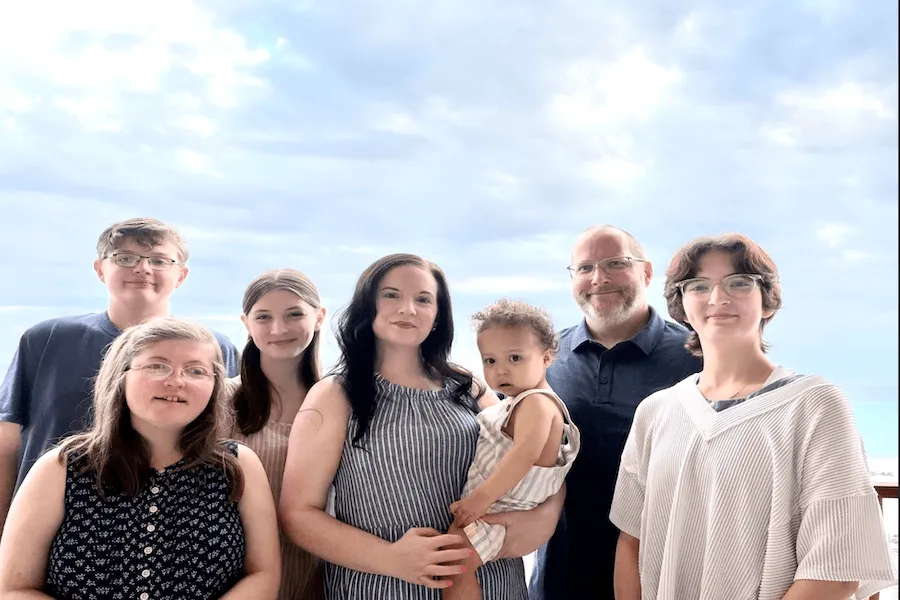
When Eric and Emily Michels married 22 years ago, they weren’t sure what the future held.
They both wanted a family, but Emily had been told as a young teen that she might not be able to have children. It was a potential reality they had discussed even while dating, with fostering being one of the options they had considered.
But about two years into their marriage, they were blessed with their first child. Over the next six years, they had three more. Fostering faded into the background as they stayed busy raising them.
Then, in January 2022, Families 4 Families’ Founder Wayne Naugle came and spoke to the Michels’ church — Vision Baptist Church in Alpharetta, Georgia. Eric and Emily were moved by his presentation, reigniting a desire to pursue fostering.
What sealed it was their own children.
“They each came to me individually to ask if fostering was something that we could do,” Emily said. “It was very special and was kind of a confirmation that, yes, we need to move forward.”
By February, they had started their training and onboarding. Not long after completing the licensing process, they accepted their first placement — siblings — a newborn and a four-year-old.
It was at the same time rewarding and challenging, Eric said, balancing emotions that come with caring for children but also having to navigate the state’s court system, which can dictate many of the decisions of a child’s well-being and when they may go back to their biological parents.
“You have to kind of remove some of those expectations of what’s going to happen, and just realize you really don’t know and can’t tell,” he said.
That uncertainty was present in their second placement, too — a boy who was with them for almost a year. The Michels weren’t sure what was going to happen to him, but they watched the biological parents come to Christ and turn their lives around. That family stays in touch with the Michels, sharing photos and updates.
“I can still see the little boy now,” Emily said, “and just to see them active in their church and the complete difference in how the children were being raised versus how they’re being raised now — that’s been very, very good.”
Through both the joys and the challenges, the Michels said their experience with fostering has been strengthened by knowing they’re being obedient to God’s call on their lives.
“I am thankful to be able to serve God in ways that He has already equipped me to do,” Emily said. “I can fill another plate at dinner. I can wash another load of clothes. Now, many days are a lot harder than that, but there are days when it is as simple as that.”
They also found comfort in their community. Several other families at their church also either foster or have adopted children, including their pastor’s family.
“Unless you foster, it’s hard to even relate to what the families go through,” Eric said. “So it’s good to share common experiences and have others who understand.”
Emily said many of those families are in their church small groups, so prayer requests are often foster-heavy, focusing on situations like court dates, biological family reunifications and other topics they’re familiar with.
Vision Baptist is also a Families 4 Families Banner Church, which means it has committed to surrounding foster families with practical, emotional and spiritual support. That support can look like meal trains, handyman services, babysitting and prayer from other church members.
The peer support groups that Families 4 Families offers have also been a lifeline to the Michels.
“I can’t emphasize meetings like moms’ nights and dads’ nights enough,” Emily said. “I know for the moms, it’s really an opportunity just to talk about things. You can talk to a friend or a family member, and they can try to offer you support, but it’s not the same as another foster mom saying, ‘I get that. I’ve done that.’ Or, ‘I’ve felt that.’ Just like in other situations, Satan wants you to feel isolated and that you’re the only one.”
They would lean on all of this when their foster journey took a turn they never expected or planned.
In October 2024, the Michels agreed to take in a newborn straight from the NICU — the hospital’s neonatal intensive care unit.
Early on, they were hopeful that his biological parents would be able to do what they needed to do to turn their lives around.
“The goal is always reunification,” Emily said.
But the biological parents didn’t get better and lost their parental rights when the baby was eight months old.
During this process, the Michels were asked whether they would consider adopting the baby if it reached that point.
“We didn’t get into this to adopt; that wasn’t our plan,” Emily said. “We just wanted to help families and be open to what God wanted us to do.”
As it looked more likely that adoption was in the baby’s future, the more the Michels allowed themselves to think it was a possibility. They proceeded carefully — guarding their hearts — knowing the baby wasn’t theirs until all the papers were finalized.
“After picking up a child at the hospital and raising them since birth … it’s one of those decisions that it’s harder to make the opposite way,” Eric said.
In January 2026, Elijah Michels became a permanent member of their family.
“People will say what a blessed boy he is to be joining our family, but really, he is a blessing to us,” Emily said.
There’s more than a decade between Elijah and their next oldest child, and they’ll both be 62 when he graduates high school; Eric and Emily would’ve been empty-nesters in three years had they not adopted.
These were concerns initially, but ones they decided to turn over to God. Emily joked that people will think they’re his grandparents someday. And nothing can replace the joy Elijah has brought to the whole family.
They didn’t stop fostering after adopting Elijah. Just as his adoption was being finalized, they said yes to fostering a baby girl.
“You’re not really starting over,” Eric said. “It’s just adding on.”